
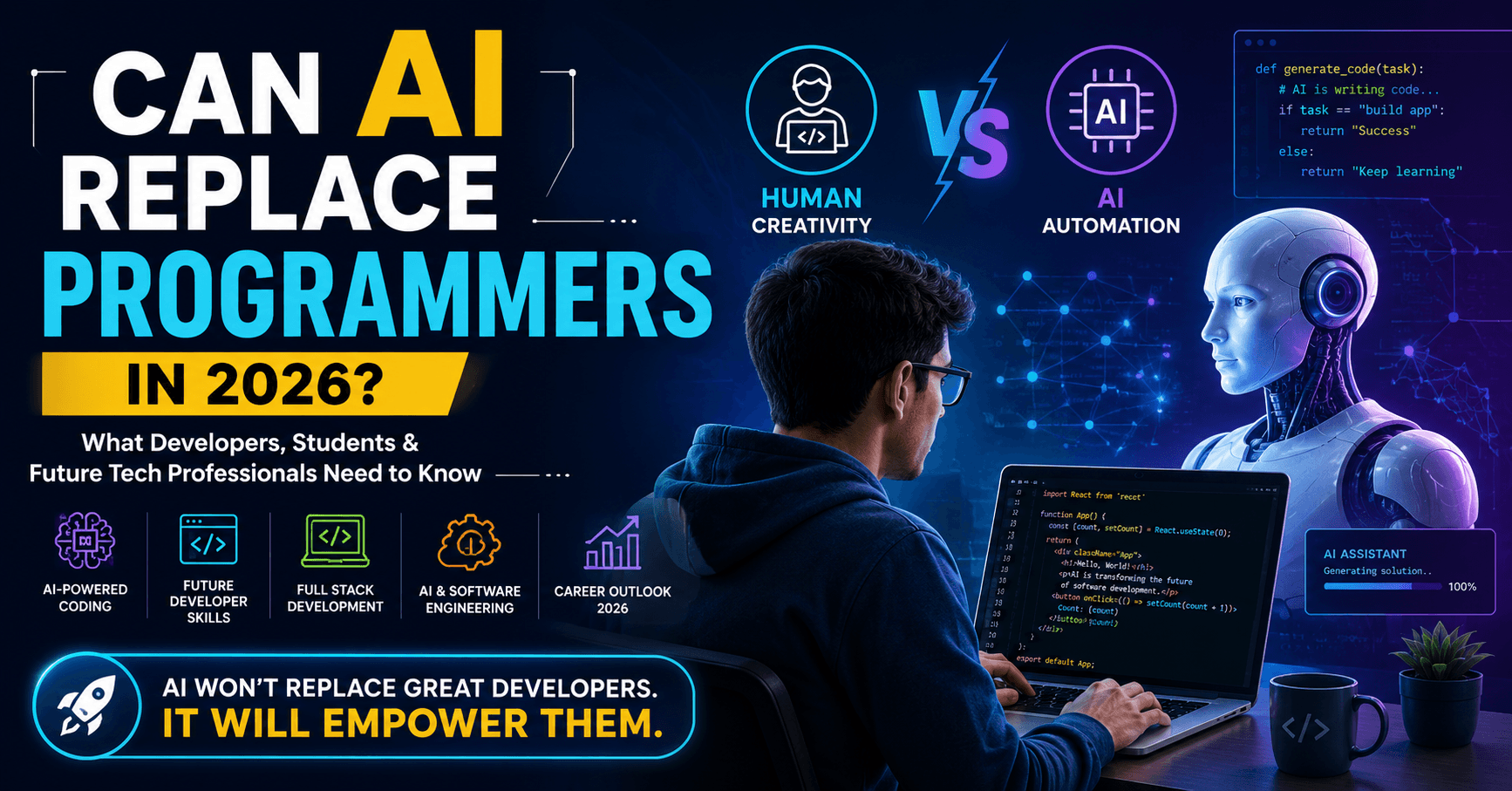
Can AI replace programmers in 2026? Discover how AI is transforming software development, what skills developers need, and why coding remains a valuable career choice.
On this page
Artificial Intelligence has become one of the most talked-about technologies in recent years. From generating code and automating repetitive tasks to building complete applications from simple prompts, AI tools are changing how software is developed. Platforms such as GitHub Copilot, ChatGPT, Claude, Gemini, and other AI coding assistants have demonstrated capabilities that once seemed impossible.
As these tools become more powerful, many students, aspiring developers, and even experienced software engineers are asking an important question:
Can AI replace programmers completely?
The concern is understandable. If AI can write code, debug applications, create websites, and generate software solutions in seconds, what role will human developers play in the future?
The reality is far more nuanced than the headlines suggest. While AI is transforming software development, it is not eliminating the need for programmers. Instead, it is changing the skills developers need and reshaping how software is built.
In this article, we'll explore what AI can do, where its limitations exist, how programming careers are evolving, and what developers need to do to remain valuable in 2026 and beyond.
The Rise of AI-Powered Coding
A few years ago, developers spent hours writing boilerplate code, searching documentation, and debugging common errors.
Today, AI tools can:
Generate code snippets
Explain programming concepts
Suggest bug fixes
Create website layouts
Write SQL queries
Generate APIs
Assist with testing
Automate repetitive coding tasks
What once required several hours can now be completed in minutes.
This shift has significantly improved developer productivity and accelerated software development processes.
Why Many People Believe AI Will Replace Programmers
Several factors contribute to this belief:
AI Can Generate Code Quickly
Modern AI models can produce functional code across multiple programming languages.
Developers can describe a feature in plain English and receive working code almost instantly.
AI Can Learn from Massive Datasets
AI systems are trained on enormous amounts of programming knowledge, allowing them to recognize patterns and generate solutions rapidly.
Companies Want Greater Efficiency
Organizations are constantly looking for ways to reduce development time and costs.
Because AI increases productivity, some people assume fewer developers will be needed.
AI Continues to Improve
Every new generation of AI models appears more capable than the previous one, creating speculation that complete automation is inevitable.
What AI Can Do Extremely Well
AI is becoming a powerful assistant for developers.
Code Generation
AI can create:
Front-end components
Backend functions
APIs
Database queries
Scripts
Bug Detection
Many AI tools can identify common coding mistakes and suggest improvements.
Documentation Creation
AI can generate:
Technical documentation
Comments
Project summaries
API documentation
Learning Assistance
Students can use AI to:
Understand programming concepts
Review code
Learn frameworks
Explore new technologies
Repetitive Development Tasks
AI excels at automating routine and repetitive work.
What AI Still Cannot Do Effectively
This is where many discussions become misleading.
Writing code is only one part of software development.
Understanding Business Requirements
Clients rarely explain exactly what they need.
Developers must:
Ask questions
Clarify requirements
Understand goals
Translate business needs into technical solutions
AI struggles with this level of human interaction.
Product Thinking
Successful applications require decisions about:
User experience
Business strategy
Customer behavior
Market needs
These decisions require human judgment.
Complex Problem Solving
Real-world software projects often involve:
Ambiguous requirements
Legacy systems
Conflicting priorities
Technical trade-offs
AI can assist but cannot independently manage these complexities.
Innovation and Creativity
AI generates outputs based on existing patterns.
Developers create new ideas, products, and solutions that may not exist in training data.
Accountability
When software fails, businesses need humans who can investigate, make decisions, and take responsibility.
AI cannot assume accountability.
The Real Question Isn't "Will AI Replace Programmers?"
The better question is:
"Will AI Replace Programmers Who Don't Adapt?"
History suggests technology rarely eliminates professions entirely.
Instead, it changes them.
Examples include:
Calculators didn't eliminate accountants.
Design software didn't eliminate designers.
Spreadsheets didn't eliminate financial analysts.
Similarly, AI is unlikely to eliminate programmers. However, it may reduce demand for developers who rely solely on basic coding skills.
Which Programming Jobs Are Most Vulnerable?
Some roles may experience greater automation.
Entry-Level Repetitive Coding
Tasks involving:
Basic CRUD applications
Simple website creation
Standard templates
Routine Maintenance Work
AI can assist with many repetitive maintenance tasks.
Basic Code Conversion
Transforming code between frameworks or languages is becoming easier with AI assistance.
Which Developer Skills Will Become More Valuable?
As AI automates coding tasks, higher-level skills become increasingly important.
System Design
Understanding how applications work at scale.
Architecture Planning
Building efficient, secure, and maintainable systems.
AI Integration
Organizations need developers who can integrate AI into products.
Cloud Computing
Modern applications increasingly rely on cloud infrastructure.
Cyber Security
Security remains a critical human responsibility.
Problem Solving
The ability to solve business challenges will continue to differentiate great developers.
Future-Proof Skills Developers Should Learn in 2026
1. Full Stack Development
Still one of the most versatile skills in the industry.
2. Artificial Intelligence & Machine Learning
Understanding AI will become essential even for non-AI developers.
3. Cloud Computing
AWS, Azure, and Google Cloud continue to dominate enterprise technology.
4. Cyber Security
Demand continues to grow globally.
5. Data Analytics
Businesses increasingly rely on data-driven decision making.
6. Prompt Engineering
Learning how to collaborate effectively with AI tools is becoming a valuable skill.
How Students Should Prepare for the Future
If you're learning programming today:
Don't Compete With AI
Learn how to use it.
Build Real Projects
Employers value practical experience more than certificates.
Strengthen Fundamentals
Focus on:
Data Structures
Algorithms
Databases
System Design
Problem Solving
Develop Communication Skills
Technical expertise alone is no longer enough.
Learn AI-Assisted Development
Future developers will work alongside AI rather than against it.
AI and Programming: A Partnership, Not a Competition
The future of software development is likely to be collaborative.
AI will handle:
Repetitive coding
Documentation
Testing support
Code suggestions
Developers will focus on:
Architecture
Innovation
Strategy
Problem solving
Business requirements
The most successful programmers won't be those who avoid AI.
They'll be the ones who know how to leverage it effectively.
Frequently Asked Questions
Can AI completely replace programmers?
No. AI can automate many coding tasks, but software development involves problem-solving, communication, creativity, architecture, and business understanding that still require human expertise.
Will programming jobs disappear because of AI?
Programming jobs are evolving rather than disappearing. Developers who learn modern technologies and AI-assisted workflows will remain in demand.
Is coding still worth learning in 2026?
Absolutely. Coding remains one of the most valuable skills in the digital economy, especially when combined with AI, cloud, cybersecurity, and problem-solving abilities.
Which developers are safest from AI automation?
Developers with expertise in system architecture, cloud computing, cybersecurity, AI integration, and business problem-solving are likely to remain highly valuable.
Final Thoughts
AI is transforming software development, but it isn't replacing programmers. While AI can automate repetitive coding tasks, it still cannot replace human creativity, problem-solving, business understanding, and decision-making. For students and developers, the goal shouldn't be to compete with AI but to learn how to use it effectively. The professionals who combine strong technical skills with AI-powered productivity will be better positioned for future opportunities. Whether you choose Full Stack Development, Artificial Intelligence, Cyber Security, Cloud Computing, or Data Analytics, continuous learning and practical experience will remain the key to long-term success.
The future belongs to developers who know how to work with AI, not those who fear it.