
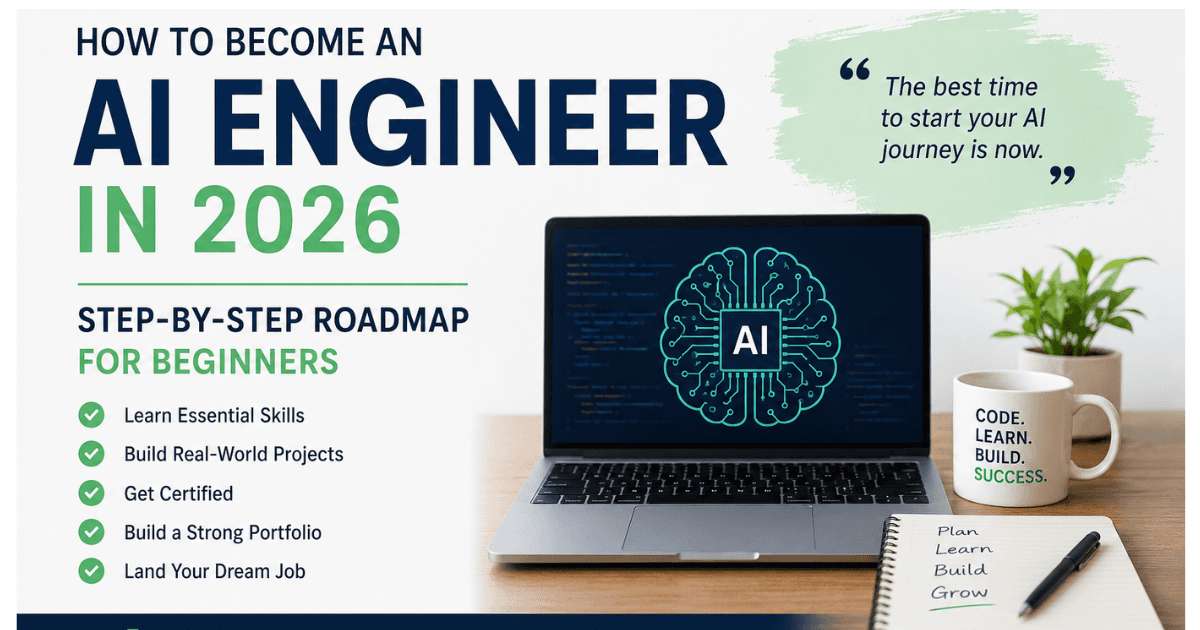
Learn how to become an AI Engineer in 2026 with this step-by-step roadmap covering Python, Machine Learning, Generative AI, projects, and careers.
On this page
Artificial Intelligence is no longer limited to research labs or large technology companies. Today, AI is transforming industries such as healthcare, banking, e-commerce, education, manufacturing, and cybersecurity. As businesses increasingly adopt AI-powered solutions, the demand for skilled AI engineers continues to rise across the globe.
If you are a student, recent graduate, or working professional looking to enter this rapidly growing field, understanding the right learning path is essential. With countless tools, frameworks, certifications, and courses available, many beginners find it difficult to determine where to start and which skills matter most.
If you're wondering how to become an AI Engineer in 2026, you're not alone. Many aspiring professionals are looking for a clear roadmap that outlines the skills, technologies, projects, certifications, and career opportunities required to succeed in the AI industry.
This guide provides a practical AI Engineer roadmap for 2026, covering everything from Python programming and Machine Learning to Generative AI, portfolio development, salary expectations, and job opportunities. By following this step-by-step approach, you can build the knowledge and hands-on experience needed to launch a successful career in Artificial Intelligence.
Quick Answer
To become an AI Engineer in 2026, start by learning Python programming, data analysis, machine learning, and deep learning fundamentals. Then explore Generative AI technologies such as Large Language Models (LLMs), AI Agents, and Retrieval-Augmented Generation (RAG). Build real-world projects, create a strong portfolio, earn industry-recognized certifications, and gain practical experience through internships or freelance work. Most learners can become job-ready within 8–12 months with consistent effort.
Key Takeaways
✔ Learn Python as your primary programming language
✔ Build a strong foundation in mathematics and statistics
✔ Master machine learning and deep learning concepts
✔ Learn Generative AI, LLMs, and AI Agents
✔ Create practical AI projects for your portfolio
✔ Develop problem-solving and analytical skills
✔ Gain hands-on experience before applying for jobs
What Does an AI Engineer Do?
An AI Engineer develops intelligent systems that can learn from data, automate tasks, and solve business problems.
Unlike traditional software developers who focus on building applications, AI engineers create systems that can make predictions, recognize patterns, and improve performance over time.
Common responsibilities include:
Building machine learning models
Developing AI-powered applications
Working with large datasets
Training and optimizing algorithms
Deploying AI solutions into production
Integrating AI capabilities into software products
AI engineers work across industries including healthcare, finance, retail, logistics, cybersecurity, and education.
Why Choose AI Engineering as a Career in 2026?
Artificial Intelligence continues to be one of the fastest-growing technology sectors globally.
Here are a few reasons why AI engineering is attracting so much attention:
High Demand Across Industries
Organizations are investing heavily in AI technologies to improve efficiency, automate repetitive tasks, and gain competitive advantages.
Attractive Salary Packages
AI professionals are among the highest-paid technology specialists due to the growing demand for their skills.
Diverse Career Opportunities
AI professionals can specialize in:
AI Engineering
Machine Learning Engineering
Data Science
Natural Language Processing (NLP)
Computer Vision
Generative AI Development
AI Product Engineering
Future-Proof Career
As AI adoption increases, demand for skilled professionals is expected to remain strong for years to come.
Not Sure Whether AI Engineering Is the Right Career Path?
Many beginners are confused about the differences between AI Engineering, Data Science, and Machine Learning careers. While these fields share certain technical skills, their responsibilities, career growth opportunities, and day-to-day work can vary significantly.
If you're still deciding which path aligns best with your interests and career goals, read our detailed comparison guide: AI vs Data Science vs AI Engineer: Which Career Path Is Best in 2026?
AI Engineer Roadmap 2026: Step-by-Step Learning Path
The biggest mistake beginners make is trying to learn everything at once. A structured learning roadmap helps you build skills gradually and avoid overwhelm.
Step 1: Learn Python Programming
Python is the most widely used programming language in Artificial Intelligence and Machine Learning. It is beginner-friendly, versatile, and supported by powerful libraries that simplify AI development.
Why Learn Python for AI?
Most AI frameworks and tools are built around Python. Learning Python first makes it easier to work with machine learning models, data analysis libraries, and Generative AI applications later in your journey.
Topics You Should Learn
Start with the fundamentals:
Variables and Data Types
Functions
Loops and Conditional Statements
Lists, Tuples, and Dictionaries
Object-Oriented Programming
File Handling
APIs & Error Handling
Recommended Timeline
Spend approximately 4–8 weeks learning Python fundamentals and building small projects.
Beginner Projects to Build
Practical projects help reinforce your learning and improve problem-solving skills.
Calculator Application
Expense Tracker
Student Management System
Weather Information App
Expected Outcome
By the end of this stage, you should be comfortable writing Python programs, working with data structures, and understanding programming concepts required for Machine Learning and AI development.
Step 2: Learn Mathematics and Statistics
Why Does Mathematics Matter in AI?
Mathematics is the foundation of Artificial Intelligence and Machine Learning. While you don't need advanced mathematical expertise to get started, understanding key concepts helps you learn how AI models make predictions, identify patterns, and improve their performance over time.
A strong mathematical foundation also makes it easier to understand machine learning algorithms, neural networks, and deep learning models.
What Should You Learn?
Focus on the following topics:
Statistics
- Mean, Median, and Mode
- Standard Deviation
- Variance
- Correlation
- Data Distribution
Probability
- Probability Basics
- Conditional Probability
- Bayes' Theorem
- Probability Distributions
Linear Algebra
- Vectors
- Matrices
- Matrix Operations
- Eigenvalues and Eigenvectors
Calculus
- Derivatives
- Gradient Descent
- Optimization Concepts
Recommended Learning Resources
- Khan Academy
- 3Blue1Brown (YouTube)
- StatQuest with Josh Starmer
- Mathematics for Machine Learning (Book)
Suggested Timeline
4–6 Weeks
Practice Activities
- Solve basic probability problems
- Analyze datasets using statistical measures
- Visualize data distributions
- Understand how gradient descent works
Expected Outcome
By the end of this stage, you should be comfortable with the mathematical concepts commonly used in Machine Learning and Deep Learning. You won't need to memorize complex formulas, but you should understand how mathematical principles support AI model training and decision-making.
Step 3: Master Data Analysis
Why Is Data Analysis Important?
AI models are only as good as the data they are trained on. Before building AI applications, you must know how to collect, clean, analyze, and visualize data.
Data analysis skills help AI Engineers make sense of datasets and prepare them for machine learning workflows.
What Should You Learn?
Data Analysis:
- Data Cleaning
- Data Transformation
- Exploratory Data Analysis (EDA)
- Data Visualization
SQL
- SELECT Queries
- Filtering Data
- Joins
- Aggregations
- Subqueries
Tools
- Pandas
- NumPy
- SQL
- Excel
- Power BI
Recommended Learning Resources
- Kaggle Learn
- SQLBolt
- Mode SQL Tutorial
- DataCamp
Suggested Timeline
4–6 Weeks
Practice Projects
- Sales Data Analysis Dashboard
- Customer Segmentation Analysis
- Student Performance Analysis
- E-commerce Data Insights
Expected Outcome
You should be able to work with datasets confidently, extract insights, and prepare data for machine learning projects.
Step 4: Learn Machine Learning
Why Learn Machine Learning?
Machine Learning is the core technology behind modern AI systems. It enables computers to identify patterns in data and make predictions without explicit programming.
Most AI applications rely heavily on machine learning algorithms.
What Should You Learn?
Supervised Learning
- Linear Regression
- Logistic Regression
- Decision Trees
- Random Forest
Unsupervised Learning
- Clustering
- K-Means
- Dimensionality Reduction
Model Evaluation
- Accuracy
- Precision
- Recall
- F1 Score
Tools and Libraries
- Scikit-Learn
- Pandas
- NumPy
- Matplotlib
Recommended Learning Resources
- Andrew Ng Machine Learning Course
- Coursera
- Kaggle Learn
- Google Machine Learning Crash Course
Suggested Timeline
6–8 Weeks
Practice Projects
- House Price Prediction
- Spam Email Detection
- Customer Churn Prediction
- Loan Approval Prediction
Expected Outcome
You should be able to build, train, evaluate, and improve machine learning models using real-world datasets.
Step 5: Learn Deep Learning
Why Learn Deep Learning?
Deep Learning powers many advanced AI systems such as ChatGPT, image recognition software, voice assistants, and autonomous vehicles.
Understanding Deep Learning opens doors to more specialized and high-paying AI roles.
What Should You Learn?
Neural Networks
- Perceptrons
- Activation Functions
- Backpropagation
Advanced Architectures
- CNNs
- RNNs
- LSTMs
- Transformers
Frameworks
- TensorFlow
- PyTorch
- Keras
Recommended Learning Resources
- DeepLearning.AI
- TensorFlow Tutorials
- PyTorch Documentation
Suggested Timeline
6–8 Weeks
Practice Projects
- Handwritten Digit Recognition
- Image Classification System
- Face Detection Application
- Emotion Recognition Model
Expected Outcome
You should understand how neural networks work and be able to build deep learning models using industry-standard frameworks.
Step 6: Learn Generative AI and Large Language Models
Why Learn Generative AI?
Generative AI is transforming industries and creating new career opportunities. Employers are actively seeking professionals who understand LLMs, AI Agents, and enterprise AI applications.
This skill set has become one of the most valuable areas in AI Engineering.
What Should You Learn?
Generative AI Fundamentals
- Prompt Engineering
- LLM Architecture
- Tokenization
- Fine-Tuning
Advanced Topics
- Retrieval-Augmented Generation (RAG)
- AI Agents
- Vector Databases
- Function Calling
Tools
- OpenAI API
- LangChain
- LlamaIndex
- Pinecone
- Weaviate
Recommended Learning Resources
- OpenAI Documentation
- LangChain Documentation
- DeepLearning.AI Generative AI Courses
Suggested Timeline
4–6 Weeks
Practice Projects
- AI Chatbot
- AI Resume Analyzer
- AI Content Assistant
- RAG Knowledge Base
- AI Customer Support Agent
Expected Outcome
You should be capable of building AI-powered applications using Large Language Models and modern Generative AI frameworks.
Step 7: Build Real-World AI Projects
Why Are Projects Important?
Projects prove your skills to employers. Recruiters often care more about practical experience than certifications. Strong projects demonstrate your ability to solve real-world business problems using AI.
What Types of Projects Should You Build?
Beginner Projects
- Spam Email Classifier
- Movie Recommendation System
- Sentiment Analysis Tool
Intermediate Projects
- Resume Screening Tool
- Customer Support Chatbot
- Face Recognition Application
Advanced Projects
- AI Agent for Business Automation
- RAG-Based Knowledge Assistant
- Multi-Agent Workflow System
Suggested Timeline
Ongoing
Expected Outcome
You should have 5–10 quality projects that showcase your technical abilities and problem-solving skills.
Step 8: Create a Professional Portfolio
Why Is a Portfolio Important?
A portfolio helps recruiters evaluate your skills and experience before scheduling interviews. It serves as proof of your capabilities and increases your chances of getting shortlisted.
What Should Your Portfolio Include?
GitHub Profile
- Project Repositories
- Clean Code
- Documentation
LinkedIn Profile
- Skills
- Certifications
- Achievements
- Project Highlights
Personal Website
- Portfolio
- Blogs
- Case Studies
- Contact Information
Job Preparation Checklist
- Build Resume
- Optimize LinkedIn Profile
- Practice AI Interview Questions
- Participate in Hackathons
- Apply for Internships
Suggested Timeline
2–4 Weeks
Expected Outcome
By the end of this stage, you should have a professional portfolio, interview-ready resume, and the confidence to apply for AI Engineer, Machine Learning Engineer, and AI Developer roles.
AI Engineer Roadmap at a Glance
Stage | Skills to Learn | Suggested Timeline |
|---|---|---|
Stage 1 | Python Programming | 1 Month |
Stage 2 | Mathematics & Statistics | 1 Month |
Stage 3 | Data Analysis & SQL | 1 Month |
Stage 4 | Machine Learning | 2 Months |
Stage 5 | Deep Learning | 2 Months |
Stage 6 | Generative AI & LLMs | 1–2 Months |
Stage 7 | Projects & Portfolio | Ongoing |
What Skills Do Recruiters Look for in AI Engineers?
Learning AI is one thing, but understanding what employers actually expect from candidates is equally important. Recruiters today are prioritizing professionals with expertise in Generative AI, Large Language Models (LLMs), AI Agents, Machine Learning, Python, and cloud-based AI tools.
To understand which skills can improve your employability and salary potential, explore our guide on Top AI Skills Employers Are Hiring for in 2026: What Recruiters Really Want.
Skill | Importance |
|---|---|
Python | Very High |
Machine Learning | Very High |
Generative AI | Very High |
SQL | High |
Deep Learning | High |
Cloud Platforms | High |
Communication Skills | High |
Problem Solving | Very High |
Best AI Certifications for Beginners
Certifications can strengthen your resume and validate your skills.
Popular options include:
Google AI Certifications
Microsoft Azure AI Certifications
IBM AI Certifications
AWS Machine Learning Certifications
TensorFlow Developer Certification
Remember: Certifications support your learning journey, but projects demonstrate your capabilities.
AI Engineer Salary in India in 2026
AI engineering continues to be one of the highest-paying technology careers.
Experience Level | Average Salary Range |
|---|---|
Fresher | ₹5–10 LPA |
1–3 Years | ₹8–18 LPA |
3–5 Years | ₹15–30 LPA |
Senior AI Engineer | ₹25–50+ LPA |
Actual compensation depends on skills, project experience, location, and employer requirements.
Common Mistakes Beginners Should Avoid
Learning Too Many Tools at Once
Master the fundamentals before exploring advanced frameworks.
Focusing Only on Certifications
Projects often carry more weight during interviews.
Ignoring SQL and Data Skills
Most AI systems depend on high-quality data.
Following Random Tutorials
Use a structured roadmap to stay focused and avoid confusion.
Can You Become an AI Engineer Without a Computer Science Degree?
Yes.
Many successful AI professionals come from backgrounds such as:
Mechanical Engineering
Electronics
Mathematics
Physics
Commerce
Business Analytics
Employers increasingly prioritize practical skills, project experience, and problem-solving abilities over academic qualifications alone.
Frequently Asked Questions
Is AI Engineering a Good Career in 2026?
Yes. AI engineering remains one of the fastest-growing and highest-paying technology careers globally.
How Long Does It Take to Become an AI Engineer?
Most beginners can become job-ready within 8–12 months through structured learning and project development.
Is Coding Required for AI Engineering?
Yes. Python programming is considered an essential skill for AI engineers.
What Is the Difference Between AI Engineering and Data Science?
AI engineers build intelligent systems and deploy AI applications, while data scientists focus on analyzing data and generating business insights.
Which Programming Language Is Best for AI?
Python is the most widely used language due to its simplicity, flexibility, and extensive AI ecosystem.
Final Thoughts
Artificial Intelligence is creating exciting opportunities for students, graduates, and professionals who want to build future-ready careers. While the field may seem complex initially, following a structured roadmap makes the learning process much more manageable. Start with Python, develop strong data and machine learning fundamentals, explore Generative AI technologies, and focus on building practical projects. Consistent learning and hands-on experience will help you stand out in a competitive job market and move closer to becoming a successful AI Engineer in 2026.