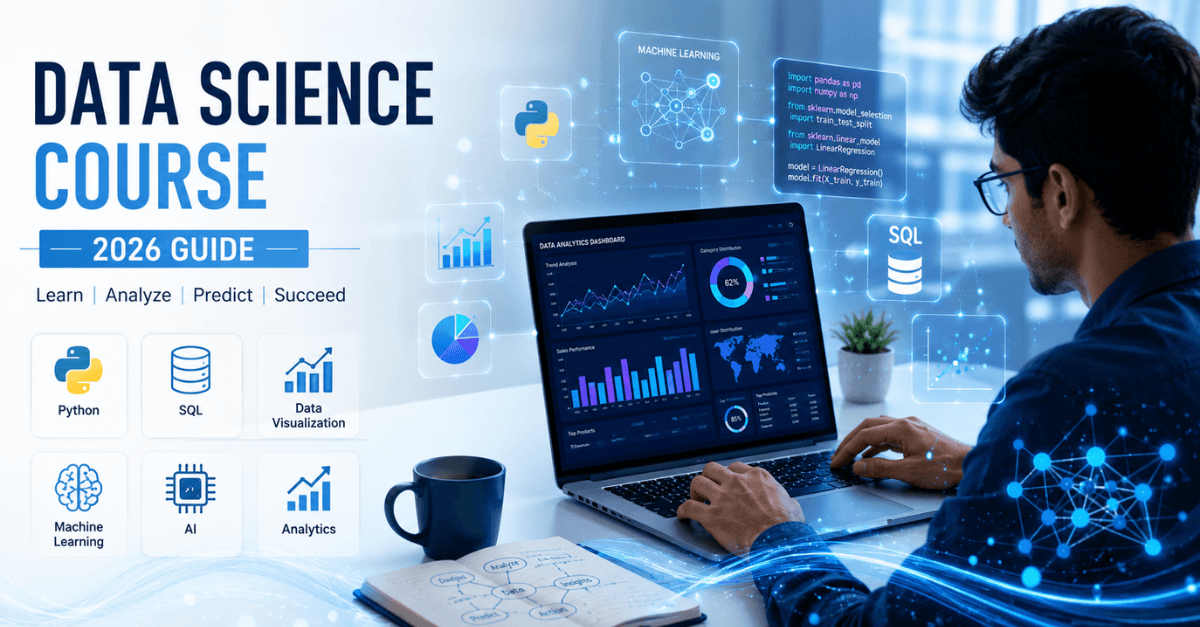
What Is a Data Science Course? Learn about its syllabus, skills, AI tools, eligibility, career opportunities, duration, and fees in this complete 2026 guide.
On this page
Data has become the foundation of modern decision-making. Whether you order food online, stream your favorite movies, shop on an e-commerce platform, or use a navigation app, data is constantly being collected and analyzed to improve user experiences. Behind these intelligent recommendations and business decisions are professionals who understand how to work with data effectively. This growing demand has made Data Science one of the fastest-growing career domains across industries. Organizations no longer rely only on intuition; they use data to predict customer behavior, improve operational efficiency, detect fraud, optimize marketing campaigns, and develop AI-powered solutions.
According to multiple industry reports, the demand for professionals skilled in data analysis, machine learning, and artificial intelligence continues to grow across sectors such as healthcare, finance, retail, manufacturing, logistics, education, and technology. As businesses generate more data than ever before, the need for professionals who can transform that data into actionable insights is expected to remain strong.
If you're exploring a career in technology, understanding what a Data Science course offers can help you decide whether it aligns with your interests and career goals.
In this comprehensive guide, we'll explain:
What a Data Science course is
Skills you'll learn
Course syllabus
Eligibility requirements
AI tools used in 2026
Career opportunities
Course duration and fees
How to choose the right learning path
Whether you're a student, graduate, or working professional, this guide will help you understand how Data Science is shaping the future of work.
What Is Data Science?
Data Science is an interdisciplinary field that combines programming, mathematics, statistics, and domain expertise to extract meaningful insights from structured and unstructured data. Rather than simply collecting information, Data Science focuses on identifying patterns, predicting outcomes, and supporting informed decision-making.
Imagine an online shopping platform recommending products based on your browsing history or a healthcare provider identifying patients at higher risk of certain conditions. These are examples of how data-driven insights help organizations improve services and solve real-world problems.
Data Science typically involves several stages:
Collecting data from multiple sources
Cleaning and preparing datasets
Exploring trends and relationships
Building predictive models
Visualizing information
Communicating findings to stakeholders
These processes enable organizations to make decisions based on evidence rather than assumptions.
What Is a Data Science Course?
A Data Science course is a structured learning program that teaches individuals how to collect, analyze, interpret, and visualize data using programming, statistics, machine learning, and modern analytical tools. Unlike short online tutorials, a comprehensive course follows a step-by-step approach, helping learners build both theoretical understanding and practical experience through projects and real-world datasets.
A well-designed course usually covers:
Programming with Python
Statistics and Probability
SQL and Database Management
Data Visualization
Machine Learning Fundamentals
Artificial Intelligence (AI) Concepts
Business Problem-Solving
Portfolio Development
As Artificial Intelligence continues to transform industries, data science professionals are expected to understand how AI, analytics, and automation work together to solve real-world business challenges. If you'd like to explore this topic in greater detail, read our guide on AI, Analytics, and the Future of Work: Where Data Science Fits In, which explains how AI is shaping modern careers in data science and analytics.
The objective is not just to teach software tools but to help learners develop analytical thinking, statistical reasoning, and practical problem-solving skills that can be applied across industries such as healthcare, finance, e-commerce, manufacturing, marketing, and technology.
Why Learn Data Science in 2026?
Technology continues to evolve, but one constant remains: organizations rely on data to make informed decisions.
In 2026, Data Science plays a significant role in areas such as:
Healthcare
Analyzing patient records, supporting diagnostics, predicting disease outbreaks, and improving treatment recommendations.
Banking and Finance
Fraud detection, credit risk assessment, investment analysis, and customer segmentation.
E-commerce
Personalized product recommendations, inventory optimization, demand forecasting, and customer behavior analysis.
Manufacturing
Predictive maintenance, quality control, and supply chain optimization.
Marketing
Campaign performance analysis, customer insights, audience segmentation, and conversion optimization.
Artificial Intelligence
As AI adoption increases, professionals who understand data science, machine learning, and artificial intelligence career paths become valuable contributors to modern technology teams.
Who Should Join a Data Science Course?
One of the biggest misconceptions is that only software engineers can pursue Data Science. In reality, learners from diverse educational and professional backgrounds can build a successful career with the right learning approach.
A Data Science course may be suitable for:
Undergraduate students
Engineering graduates
Computer Science students
Mathematics and Statistics graduates
Commerce graduates interested in analytics
MBA graduates
Working professionals seeking career growth
Business analysts
Software developers
Digital marketers who work with analytics
Entrepreneurs interested in data-driven decision-making
Success in Data Science depends more on curiosity, logical thinking, and a willingness to solve problems than on a specific academic background.
Eligibility for a Data Science Course
Eligibility requirements vary depending on the institution and the level of the course. However, many beginner-friendly programs are designed to accommodate learners with different educational backgrounds.
Common eligibility criteria include:
Basic computer knowledge
Interest in technology and analytics
Familiarity with mathematics (helpful but not always mandatory)
Willingness to learn programming
Problem-solving mindset
Advanced or postgraduate programs may require prior experience in programming, mathematics, or related disciplines, while foundational courses often start with the basics.
A comprehensive Data Science course develops both technical and professional skills.
Technical Skills
Python Programming
SQL
Data Cleaning
Exploratory Data Analysis (EDA)
Statistics
Probability
Machine Learning
Data Visualization
Feature Engineering
Model Evaluation
AI Fundamentals
Dashboard Development
Soft Skills
Analytical Thinking
Problem Solving
Critical Reasoning
Communication
Presentation Skills
Business Understanding
Collaboration
Continuous Learning
These skills help professionals analyze information effectively and communicate insights to technical and non-technical audiences.
Complete Data Science Course Syllabus
Although curricula differ between institutes, a modern Data Science program generally includes the following modules.
Module 1: Introduction to Data Science
Data Science lifecycle
Applications across industries
Types of data
Data-driven decision-making
Module 2: Python Programming
Variables
Data types
Loops
Functions
File handling
Object-Oriented Programming
Libraries such as NumPy and Pandas
Module 3: Statistics & Probability
Mean
Median
Mode
Standard deviation
Probability distributions
Correlation
Regression
Hypothesis testing
Module 4: SQL & Database Management
SELECT queries
WHERE clause
GROUP BY
ORDER BY
JOIN operations
Aggregate functions
Views
Basic database design
Module 5: Data Cleaning
Missing values
Duplicate records
Data transformation
Feature engineering
Handling inconsistent data
Module 6: Exploratory Data Analysis
Descriptive statistics
Correlation analysis
Pattern identification
Outlier detection
Data storytelling
Module 7: Data Visualization
Students learn to present complex information using dashboards and visual reports.
Popular tools include:
Power BI
Tableau
Matplotlib
Plotly
Module 8: Machine Learning
Topics generally include:
Supervised learning
Unsupervised learning
Regression
Classification
Clustering
Decision Trees
Random Forest
Model evaluation techniques
Module 9: AI Fundamentals
Modern courses increasingly introduce learners to AI concepts, including:
Generative AI
Prompt Engineering
AI-assisted analytics
Responsible AI
Large Language Models (LLMs)
Rather than replacing Data Science, AI complements it by enabling professionals to work more efficiently with data and automate certain analytical tasks.
Tools Commonly Used in Data Science
Students are often introduced to a range of industry tools, including:
Python
Jupyter Notebook
Google Colab
SQL
Power BI
Tableau
Git & GitHub
Excel
NumPy
Pandas
Matplotlib
Scikit-learn
Learning these tools through practical projects helps build confidence and prepares learners for real-world workflows.
Why Practical Projects Matter
Theoretical knowledge alone is rarely enough for a career in Data Science. Employers often look for candidates who can demonstrate how they apply concepts to solve problems.
Hands-on projects allow learners to:
Practice data cleaning and analysis
Build machine learning models
Create interactive dashboards
Work with real-world datasets
Showcase their skills through a professional portfolio
Examples of beginner-friendly projects include sales forecasting, customer segmentation, movie recommendation systems, and sentiment analysis.
Data Science Course Duration in 2026
One of the most common questions students ask is, "How long does it take to learn Data Science?" The answer depends on your learning goals, prior experience, and the depth of the course you choose.
A short introductory program may help you understand the fundamentals, while a comprehensive industry-oriented course focuses on practical skills, portfolio development, and career readiness.
Generally, Data Science courses fall into these categories:
Course Type | Typical Duration |
|---|---|
Introductory Course | 4–8 Weeks |
Certificate Course | 3–6 Months |
Advanced Professional Course | 6–12 Months |
Diploma / PG Program | 12–24 Months |
Remember that learning Data Science does not stop after completing a course. The technology landscape evolves continuously, making continuous learning an important part of every professional's career.
How Much Does a Data Science Course Cost?
The cost of a Data Science course can vary significantly depending on several factors, including the depth of the curriculum, training format, instructor expertise, and career support offered by the institute. Rather than choosing a course based solely on its fees, it's important to evaluate the overall learning experience and long-term career value.
Some of the key factors that influence course fees include:
Course Duration
Mode of Learning (Online or Classroom)
Live Projects and Case Studies
Placement Assistance
One-on-One Mentorship
Industry-Recognized Certification
Institute Reputation and Faculty Experience
A high-quality Data Science course should focus on developing practical skills through hands-on learning rather than relying only on theoretical concepts. Before enrolling, look for a program that includes:
Practical Assignments
Real-World Datasets
Machine Learning Projects
Portfolio Development
Resume Building
Mock Interviews and Interview Preparation
Career Mentoring and Placement Support
If you're looking for classroom-based, industry-oriented training with live projects and placement assistance, you can explore our Data Science Course in Mohali to learn about the curriculum, training methodology, certification, and career support available for aspiring data professionals.
A course that combines expert guidance, hands-on experience, and career-focused learning often delivers far greater long-term value than one that emphasizes theory alone. Investing in quality training can help you build job-ready skills and improve your career prospects in the rapidly growing field of data science.
Online vs Offline Data Science Courses
Choosing between online and offline learning depends on your schedule, learning preferences, and access to mentorship.
Online Learning
Advantages:
Flexible schedule
Learn from anywhere
Self-paced study
Recorded sessions
Lower travel costs
Challenges:
Requires self-discipline
Limited classroom interaction
Less immediate doubt resolution
Offline Learning
Advantages:
Face-to-face interaction
Structured learning
Immediate instructor support
Classroom discussions
Better networking opportunities
Challenges:
Fixed timings
Daily commute
Less flexibility
Some learners also benefit from hybrid learning, which combines classroom instruction with online resources.
Certifications in Data Science
Although certifications can demonstrate learning, employers often look beyond certificates.
Recruiters usually evaluate candidates based on:
Technical skills
Practical projects
Problem-solving ability
Portfolio
GitHub profile
Communication skills
Certifications become more valuable when supported by hands-on experience and real project work.
Essential Tools Every Data Science Student Should Learn
Technology continues to evolve rapidly, and today's data science professionals are expected to be proficient with a wide range of tools used for data analysis, machine learning, visualization, and AI-assisted development. Learning these tools not only builds technical expertise but also prepares students for real-world projects and industry requirements.
Programming
Python
SQL
Data Analysis
Pandas
NumPy
Data Visualization
Power BI
Tableau
Matplotlib
Plotly
Machine Learning
Scikit-learn
TensorFlow
PyTorch (Basic Understanding)
Development & Collaboration
Jupyter Notebook
Google Colab
Git
GitHub
AI Productivity Tools
ChatGPT
GitHub Copilot
Google AI Studio
Claude
As Artificial Intelligence becomes an integral part of modern analytics, learning how to use AI tools responsibly can significantly improve productivity, automate repetitive tasks, and support faster data-driven decision-making. To better understand how AI, analytics, and data science are shaping the future of careers and businesses, explore our article AI, Analytics, and the Future of Work: Where Data Science Fits In. While AI-powered tools can accelerate coding, documentation, and data exploration, they should complement—not replace—core analytical thinking, statistical knowledge, and problem-solving skills. Employers continue to value professionals who can interpret results, validate insights, and make informed business decisions based on data.
Career Opportunities After Completing a Data Science Course
Data Science skills are in high demand across industries as organizations increasingly rely on data-driven decision-making to improve efficiency, enhance customer experiences, and gain a competitive advantage. Completing a Data Science course can open doors to a wide range of career opportunities in both established companies and fast-growing startups.
Some of the most popular career paths include:
Data Analyst
A Data Analyst collects, cleans, and interprets data to identify trends, generate reports, and provide actionable insights that support business decisions.
Data Scientist
Data Scientists use programming, statistics, and machine learning to build predictive models, uncover hidden patterns, and solve complex business problems using large datasets.
Machine Learning Engineer
Machine Learning Engineers design, develop, and deploy machine learning models that power intelligent applications such as recommendation systems, fraud detection, and predictive analytics.
Business Intelligence Analyst
Business Intelligence (BI) Analysts create interactive dashboards and visual reports using tools like Power BI and Tableau to help organizations monitor performance and make informed strategic decisions.
AI Engineer
AI Engineers develop and implement artificial intelligence solutions using machine learning, deep learning, and automation technologies to create intelligent systems for various industries.
If you're unsure which path aligns best with your aspirations, read our comprehensive guide on AI vs Data Science vs AI Engineer: Which Career Path Is Best in 2026? The article compares job roles, required skills, salary expectations, and future career prospects to help you make an informed decision.
With continuous learning, hands-on project experience, and industry-recognised certifications, professionals in these roles can find opportunities in sectors such as healthcare, finance, e-commerce, manufacturing, education, telecommunications, and technology.
Data Engineer
Develops and manages the infrastructure used for storing and processing large volumes of data.
Analytics Consultant
Helps organizations solve business challenges using analytical techniques and data-driven strategies.
Industries Hiring Data Science Professionals
Data Science is no longer limited to technology companies. Professionals work across industries such as:
Healthcare
Banking
Finance
Insurance
Retail
Manufacturing
E-commerce
Telecommunications
Education
Government
Logistics
Sports Analytics
Digital Marketing
Travel and Hospitality
The diversity of applications makes Data Science a versatile career option.
Is Data Science Still a Good Career in 2026?
Yes—but the nature of the role is evolving. Artificial Intelligence has automated some repetitive tasks, but it has also created demand for professionals who understand data quality, model evaluation, business context, and ethical AI practices.
Successful professionals are increasingly expected to combine:
Programming skills
Statistical knowledge
Business understanding
AI literacy
Communication skills
Rather than replacing Data Scientists, AI tools are changing how they work and increasing the importance of analytical thinking.
How to Choose the Right Data Science Course
Before enrolling, consider the following questions:
Does the curriculum cover current industry tools?
Look for topics such as Python, SQL, Machine Learning, AI fundamentals, and data visualization.
Does the course include practical projects?
Projects demonstrate your ability to apply concepts in real-world scenarios.
Is there mentorship available?
Experienced mentors can help clarify difficult concepts and provide career guidance.
Does the course support portfolio building?
A portfolio often carries more weight than a certificate during interviews.
Does it include interview preparation?
Resume reviews, mock interviews, and career support can improve job readiness.
Is the content regularly updated?
Technology changes rapidly, so the curriculum should reflect current industry practices.
Common Mistakes Beginners Should Avoid
Many learners slow their progress by making avoidable mistakes.
Some common ones include:
Focusing only on theory
Ignoring Python practice
Skipping SQL
Not building projects
Avoiding statistics
Learning too many tools at once
Neglecting GitHub
Copying projects without understanding them
Giving up after encountering difficult concepts
Consistent practice often leads to better results than trying to learn everything at once.
Frequently Asked Questions (FAQ)
What is a Data Science course?
A Data Science course teaches learners how to collect, analyze, visualize, and interpret data using programming, statistics, machine learning, and analytical tools.
Who can join a Data Science course?
Students, graduates, working professionals, engineers, commerce graduates, and individuals interested in analytics can all learn Data Science.
Is coding mandatory for Data Science?
Basic programming knowledge is important, but many beginner-friendly courses teach coding from the fundamentals.
Which programming language is most commonly used?
Python is widely used because of its simplicity and extensive libraries for data analysis and machine learning.
How long does it take to learn Data Science?
The duration depends on the course and learning pace. Foundational programs may take a few months, while advanced programs can take longer.
Is mathematics important?
Basic mathematics and statistics are helpful, but many courses introduce these concepts gradually.
Can I learn Data Science without an engineering background?
Yes. Many learners from commerce, business, mathematics, economics, and other disciplines successfully transition into Data Science.
Is Data Science a good career in 2026?
Data Science continues to offer strong career opportunities as organizations increasingly rely on data and AI-driven decision-making.
Which industries hire Data Science professionals?
Healthcare, finance, retail, manufacturing, education, logistics, marketing, technology, and many other sectors hire professionals with Data Science skills.
What should I learn before starting?
Basic computer knowledge, logical thinking, and an interest in data analysis provide a good foundation.
Final Thoughts
Data Science has evolved into one of the most impactful technology disciplines, helping organizations transform information into meaningful decisions. As industries continue adopting artificial intelligence, cloud computing, and advanced analytics, professionals who can work effectively with data remain in demand. However, success in this field depends on more than learning a few tools.
Building a strong foundation in programming, statistics, problem-solving, and practical project work is essential for long-term growth. If you're planning to begin your learning journey, focus on understanding concepts, practicing consistently, and building a portfolio that demonstrates your skills. Technology will continue to evolve, but the ability to analyze data, solve problems, and communicate insights will remain valuable across industries.