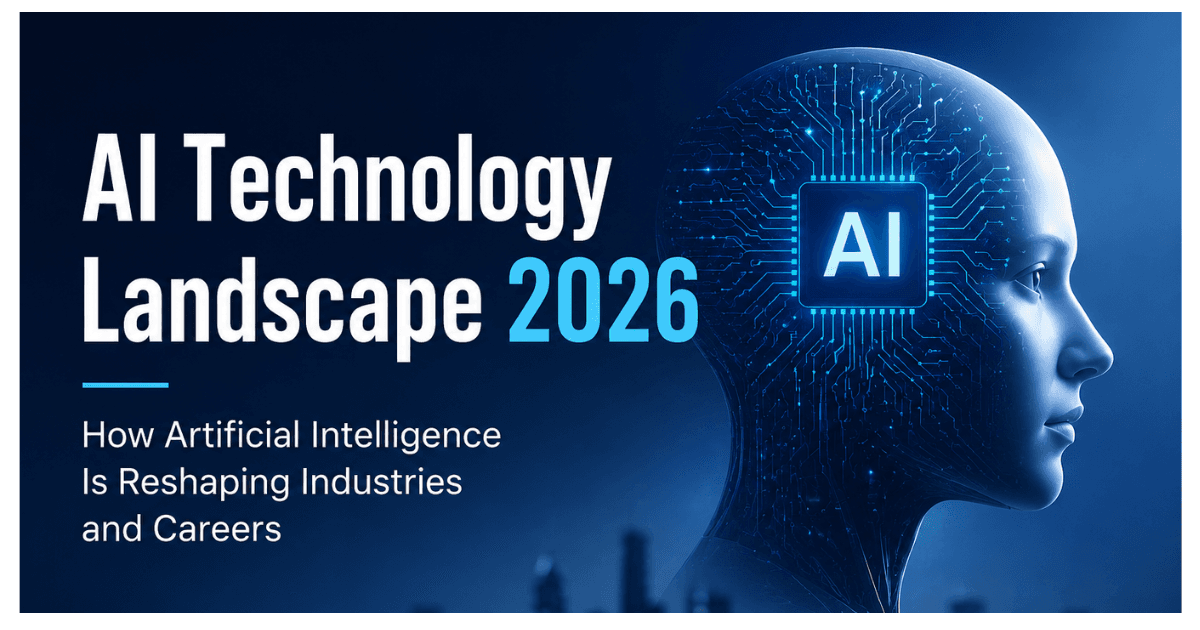
Learn how Artificial Intelligence and Smart Solutions are reshaping industries, driving digital transformation, and creating new career opportunities in 2026.
On this page
Introduction
Artificial Intelligence (AI) has evolved from an emerging technology into a driving force behind digital transformation. What once seemed like a futuristic concept is now powering everyday applications, business operations, customer experiences, and decision-making processes across industries.
From intelligent chatbots and predictive analytics to autonomous systems and generative AI tools, organizations worldwide are leveraging AI to improve efficiency, reduce costs, and unlock new opportunities. As AI adoption continues to accelerate in 2026, businesses and professionals must understand how this technology is reshaping the modern technology landscape.
In this article, we explore how Artificial Intelligence is transforming industries, creating new career opportunities, driving business innovation, and shaping the future of work. We also examine the most valuable AI skills, emerging trends, and practical ways professionals can prepare for an AI-driven future.
What Is Artificial Intelligence (AI)?
Artificial Intelligence (AI) refers to computer systems and software that can perform tasks typically requiring human intelligence. These tasks include learning from data, recognizing patterns, understanding language, making decisions, solving problems, and generating content.
Today, AI powers virtual assistants, recommendation engines, intelligent search systems, predictive analytics platforms, and automated business workflows. As organizations continue to adopt AI technologies, the technology is becoming a core component of modern digital transformation strategies.
Key Takeaways
AI is transforming healthcare, finance, retail, manufacturing, education, and software development.
Businesses are using AI to improve efficiency, automate tasks, and enhance customer experiences.
AI-related careers continue to experience significant growth across industries.
Skills such as Python, Machine Learning, NLP, Data Analysis, and Cloud Computing remain highly valuable.
Organizations that embrace AI strategically can gain a strong competitive advantage.
Continuous learning is essential for professionals seeking long-term success in the AI era.
What Is Driving the Rapid Growth of AI?
Several factors have contributed to the widespread adoption of Artificial Intelligence.
Increased Data Availability
Businesses generate enormous volumes of data every day. AI systems can process, analyze, and extract insights from this information much faster than traditional methods, helping organizations make informed decisions.
Advanced Computing Power
Cloud computing, GPUs, and high-performance hardware have made AI development more accessible and cost-effective for businesses of all sizes.
Generative AI Innovations
The rise of Large Language Models (LLMs) and AI-powered content generation tools has transformed how organizations create content, automate workflows, improve customer support, and enhance productivity.
Demand for Automation
Organizations are increasingly seeking ways to automate repetitive tasks, reduce operational costs, improve accuracy, and boost productivity. AI-powered automation helps businesses achieve these goals at scale.
How AI Is Transforming Key Industries
Healthcare
AI is revolutionizing healthcare through:
Medical image analysis
Disease prediction
Virtual health assistants
Personalized treatment recommendations
Drug discovery and research
Healthcare providers can identify patterns and risks more quickly, improving patient outcomes while reducing administrative burdens.
Banking and Finance
Financial institutions use AI for:
Fraud detection
Risk assessment
Customer support automation
Investment analysis
Credit scoring
AI enables faster decision-making while improving security, compliance, and customer satisfaction.
E-Commerce and Retail
Retailers leverage AI to:
Recommend products
Forecast demand
Optimize inventory
Improve customer experiences
Automate customer service
AI-powered personalization has become a significant competitive advantage for online businesses.
Manufacturing
Manufacturers use AI to:
Predict equipment failures
Improve quality control
Optimize supply chains
Reduce production costs
Enhance workplace safety
Predictive maintenance solutions help organizations reduce downtime and improve operational efficiency.
Education
Educational institutions are integrating AI through:
Personalized learning experiences
Intelligent tutoring systems
Automated assessments
Learning analytics
Virtual learning assistants
AI enables educators to deliver more customized and effective learning experiences.
Real-World Examples of AI Adoption in 2026
AI is no longer limited to experimental projects. Organizations are implementing AI solutions to solve real business challenges and improve performance.
Healthcare providers use AI-assisted diagnostic tools to support early disease detection.
Financial institutions use AI algorithms to identify fraudulent transactions in real time.
E-commerce platforms leverage recommendation engines to increase customer engagement and sales.
Manufacturers implement predictive maintenance systems to reduce equipment failures.
Educational institutions use AI-powered learning platforms to personalize student learning experiences.
These examples demonstrate how AI is creating measurable value across multiple industries.
The Rise of Intelligent Automation
One of the most significant impacts of AI is intelligent automation. Unlike traditional automation, which follows predefined rules, AI-powered systems can learn from data, adapt to changing conditions, and continuously improve performance. Businesses are increasingly using intelligent automation for:
Customer support
Data processing
Marketing campaigns
Human resource management
Financial operations
This shift allows employees to focus on strategic, creative, and high-value activities while repetitive tasks are handled automatically.
How AI Is Creating New Career Opportunities
Contrary to concerns about job displacement, AI is creating entirely new career paths.
Organizations require professionals who can build, deploy, manage, and optimize AI-powered systems. Some of the fastest-growing roles include:
AI Engineer
Machine Learning Engineer
Data Scientist
AI Product Manager
Prompt Engineer
AI Solutions Architect
AI Research Analyst
Data Engineer
As demand continues to grow, employers are actively seeking professionals with both technical expertise and practical AI implementation skills. For individuals interested in entering this field, understanding the right learning path is essential. Our guide on becoming an AI Engineer in 2026 provides a step-by-step roadmap covering the skills, tools, certifications, and practical experience needed to launch a successful AI career.
The Most Valuable AI Skills in 2026
Professionals entering the AI field should focus on developing both technical and workplace skills. As AI adoption continues to grow across industries, employers are actively seeking candidates with expertise in machine learning, data analysis, cloud technologies, and AI deployment. To learn which skills are currently most in demand and why recruiters prioritize them, read our guide on Top AI Skills Employers Are Hiring for in 2026: What Recruiters Really Want.
Technical Skills
Python Programming
Machine Learning
Deep Learning
Data Analysis
Natural Language Processing (NLP)
Computer Vision
Cloud Platforms
AI Model Deployment
Workplace Skills
Problem Solving
Communication
Critical Thinking
Project Management
Business Understanding
Employers increasingly value candidates who can combine technical knowledge with the ability to solve real-world business challenges.
AI vs Data Science vs AI Engineering
Many students and professionals struggle to choose the right technology career path.
AI Engineers focus on designing, developing, and deploying intelligent systems, while Data Scientists analyze data to uncover business insights and Machine Learning Engineers build and optimize AI models.
If you're unsure which role aligns best with your skills and career goals, explore our detailed guide on AI vs Data Science vs AI Engineer to understand the responsibilities, required skills, salary expectations, and career opportunities associated with each path.
Choosing the right path depends on your interests, technical background, and long-term career goals.
Why Full-Stack Developers Should Learn AI
As AI-powered applications become increasingly common, software developers are expected to integrate intelligent features into modern web and mobile applications.
Examples include:
AI chatbots
Recommendation engines
Intelligent search systems
Automated workflows
Predictive analytics
Developers who combine full-stack development expertise with AI knowledge can build smarter applications and increase their value in the job market. Professionals interested in building modern AI-powered web applications should also explore our guide on Full Stack Development Course in Mohali: Skills, Career Opportunities, Salary & Learning Roadmap for 2026.
The Importance of Professional Training
Technology continues to evolve rapidly, making continuous learning essential for career growth.
Professional training programs help learners:
Gain hands-on experience
Work on real-world projects
Learn industry-standard tools
Build professional portfolios
Improve employability
Structured learning environments also provide mentorship, practical guidance, and exposure to industry best practices.
How Businesses Can Prepare for an AI-Driven Future
Organizations looking to maximize AI benefits should:
Invest in employee upskilling
Build strong data management practices
Identify automation opportunities
Implement responsible AI policies
Monitor AI performance and outcomes
Align AI initiatives with business objectives
Businesses that combine technology adoption with workforce development are often better positioned for sustainable growth.
Challenges Organizations Face When Implementing AI
Despite its benefits, AI adoption comes with challenges:
Data privacy concerns
Ethical considerations
Model bias
Security risks
Talent shortages
Integration complexities
Organizations that address these challenges proactively are more likely to achieve long-term success.
The Future of AI Beyond 2026
The next wave of AI innovation is expected to focus on:
Autonomous AI agents
Hyper-personalized digital experiences
Advanced robotics
AI-powered cybersecurity
Intelligent enterprise automation
Human-AI collaboration systems
Businesses that embrace these technologies early may gain significant competitive advantages.
Frequently Asked Questions (FAQs)
What are the most common uses of AI in 2026?
AI is commonly used for customer support, predictive analytics, recommendation systems, fraud detection, intelligent automation, healthcare diagnostics, and content generation.
Is AI replacing jobs?
AI is automating some repetitive tasks, but it is also creating new career opportunities in AI engineering, machine learning, data science, and intelligent automation.
What skills are needed for a career in AI?
Key AI skills include Python programming, machine learning, deep learning, data analysis, NLP, cloud computing, and problem-solving.
Which industries benefit most from AI?
Healthcare, finance, retail, manufacturing, logistics, education, and software development are among the industries benefiting most from AI adoption.
Why is AI important for businesses?
AI helps businesses improve efficiency, automate routine processes, reduce costs, enhance customer experiences, and make data-driven decisions.
Conclusion
Artificial Intelligence is no longer a technology of the future—it is a fundamental part of today's digital economy. From healthcare and finance to software development and education, AI is transforming how organizations operate and how professionals build successful careers.
As businesses continue investing in AI-powered solutions, the demand for skilled professionals will only increase. Whether you are a student, recent graduate, developer, or working professional, now is an ideal time to build AI-related skills and prepare for future opportunities.
Organizations and individuals that embrace continuous learning, innovation, and responsible AI adoption will be best positioned to thrive in the technology landscape of 2026 and beyond.